


My INDOscribable SEA-Teacher Experience
- dominicjrbutac
- Dec 21, 2023
- 12 min read
Updated: Dec 31, 2023
This blog encompasses my SEA-Teacher Experience where I will be sharing topics that relate to teaching and learning process, which I found relevant and useful for educational purposes. These are further elaborated through the following paragraphs. Take your time reading, in hopes of finding significant information from my INDOscribable teaching and learning experience!
School: General Information and Academic Administration
School Profile
Understanding SMAN 10 can be better done by having an information about its brief yet rich history. The following paragraphs will give light to when and how was the school established and how it developed further through the ideas and efforts of the people involved and the government sectors in-charge.
I was able to tour enough around the school and saw the technological resources and facilities. This can be seen through the pictures I took during my stay in SMAN 10.


A Brief History
SMA Negeri 10 Samarinda is a State Senior High School in East Kalimantan Province, Indonesia. Similar to high schools in general in Indonesia, the school education period at SMA Negeri 10 Samarinda takes three years of study from Class X to Class XII. This school is a school located in East Kalimantan Province, with students coming from 14 cities/districts in East Kalimantan Province and outside East Kalimantan.
Brief History. The idea of establishing SMA Negeri 10 Samarinda began with the development of the discourse on establishing superior schools in the East Kalimantan area by ICMI Orwil Kaltim, then this idea was followed up with the publication of SK.No.200. P/ICMI-KT/I/1994 formed a Superior High School Pioneer Team chaired by the Chancellor of Mulawarman University, Prof. Ir. H. Rahmad Hernadi, M.Sc. After going through a long process, SMA Negeri 10 Samarinda was established based on the Decree of the Minister of Education and Culture of the Republic of Indonesia Number 107/O/1997 concerning the Opening and Management of Schools for the 1995/1996 Academic Year dated 16 May 1997 and its existence was inaugurated by the Minister of the Department of Education and Culture, Prof. DR. Eng. Wardiman Djojonegoro on December 11, 1997.
SMA Negeri 10 Samarinda is a superior boarding school (boarding school) resulting from collaboration between the Regional Office of Education and Culture of East Kalimantan Province and the Melati Samarinda Foundation on October 30, 1994 with a Notarial Deed No. 78 dated April 15, 1994. However, since the Melati Samarinda Foundation Statement Letter Number 099/01.05/P.YM-KT/VI/2010 concerning Termination of Cooperation Relations between the East Kalimantan Provincial Education Service and the Melati Foundation, SMA Negeri 10 Samarinda has not collaborated again with the Melati Samarinda Foundation so that starting in 2010 the management of schools and dormitories was handled directly by the East Kalimantan Provincial Education Office.
Since its inauguration until now, SMA Negeri 10 Samarinda has been led by the Principal as follows:
Drs. Harimurti, W.S. (1997 to 1998)
Drs. H. Zainal Abidin (1998 to 2000)
Drs. H. Suwardi, M.M. (2000 to 2008)
Drs. Hidayat (2009 to 2012)
Armin, S.Pd., M.Pd. (2012 to 2017)
Drs. H. Agus Gazali, M.S.I. (2017 to 2020)
Sutrisno, M.Pd. (2020 to 2021)
Suharno, S.Pd., M.Sc. (2021 to 2023)
Fathur Rachim, S.Kom., M.Pd. (2023 to Now)
Same information can be read through the school’s official website which can be accessed on:
The vice-principal and teachers were also very accommodating in welcoming me in my first day at the school, which can be seen from the pictures below:


Academic Support System
With my stay in the school, I observed that students are very supported with their academic endeavors both inside and outside the classroom. Due to the school being a public school, they are provided with the technological materials they need as well as the facilities that are crucial for them to have a better learning experience. In addition to this is the guidance of highly dedicated teachers in supporting the students in their academic journey, which is key to every successful learner.
Teaching System
The teaching system of the school has always been governed with considerations from different parties with even quoting one of the English teachers Ms. Ismi Purnama saying:
"I always tried to make students enjoy the lesson and not only sit and listen to the teacher’s explanation, but the students themselves should be involved to the activities so that they can experience the key point of learning. It also aligns with the government’s purposes that the curriculum should be student-centered, which is teaching approach places the learner at the center of the educational process, focusing on their needs, interests, and active participation."
MS. ISMI PURNAMA, English Teacher
I took the opportunity of being in one frame together with Ms. Ismi that can be seen below:


Ms. Ismi, I would say, is one of the most patient teachers to me whenever I have concerns and questions in selecting topics to teach to my students; asking requests whenever I am having difficulty in attending my classes on time due to unprecedented circumstances; and requesting to share her knowledge about some parts of this blog. Truly, she was an immense help for me, which I believe made my demonstration teachings in the school successful. Equally, Ms. Dini, Mr. Tasrin, and Mr. Rais lend me a hand throughout my teaching classes, which resulted in favorable results.
Materials and Other Learning Sources
The tangible materials that students need in the learning process were provided by the teacher. For instance, when I observed in one of the classes before I had my demonstration teachings, the teacher provided a worksheet for them to use rather than the students writing it on a piece of paper then doing the task afterwards. In terms of other learning sources, students usually use their smartphones, tablets, and laptops with the aid of the internet to search for relevant information for their lessons, which makes the learning process technology-driven that conforms to their curriculum to make students 21st century learners.
Snapshots below show the students using their laptops in relation to technology-supported classroom.


Measurement and Evaluation System
With the continued help of Ms. Ismi, I was able to know that in her classes, the measurement and evaluation system differ from one topic to another as she believes that the best evaluation for students is the one that is fair, comprehensive, and aligned with the learning objectives. In addition to this is that she regularly assesses her students’ understanding throughout the learning process by asking them processing questions and have a discussion. She further added that by conducting classroom observations, it is easier to assess students' participation, engagement, and behavior. Finally, giving them a project-based work also help her to evaluate students based on their ability to apply knowledge and skills to real-world settings.
Curriculum
The curriculum emphasizes the development of 21st-century skills such as critical thinking, problem-solving, collaboration, and creativity, which seek to prepare students for the challenges of the modern world and promote a lifelong love of learning. Undeniably, lessons inside the classroom should not be limited to paper-and-pencils tests but should be complemented with authentic assessments, so learners would know how to apply these in real-life set-ups and be more navigated to the complexity of the how the world works.
Teaching Plan (of Your Major)
In administering one of my demonstration teachings, I was able to create a lesson plan describing the teaching process following the 4-A lesson plan model which includes Activity, Analysis, Abstraction, and Application. Although there are other parts of the lesson plan that were not really part of the model, this can be better understood through reading a copy of the lesson provided below.
PEDAGOGICAL CONTENTS
Teaching Methods
During one of my observations in SMAN 10 particularly in an English class, the teacher employed a student-centered way of teaching the students where the use of technology-based teaching was used by the teacher where she let the students to listen to an audio-visual material specifically a song. From the listening activity, they shall then decipher the lyrics of the song where they are given a worksheet to accomplish in which collaboration among the students was fostered. Tapping the use of technology when teaching 21st century learners has become a need than a choice because students nowadays are leaning toward the use of technology in everyday life especially in learning opportunities as cellphones, laptops, internet have become a necessity.
The images below show the class observed doing the listening activity and the worksheet.


Learning Materials and Innovation
Following the observation above-mentioned, audio-visual material was provided by the teacher for the students to listen. This material was key in enhancing the listening skill of the students as this skill is one of the most crucial skills to develop. Further, this will be relevant in acquiring the other skills such as speaking, writing, and reading. However, the song that was provided to the students was a bit outdated; therefore, opting for a more trendy and popular music is more desirable to attract the attention of the students and for them to feel more interested in listening to the music. Further, song choice is crucial as the song taste of students nowadays are leaning towards cool and up-to-date type of music.
Sources of Learning and Technology
As learning is a two-way process, the teacher and the students were able to share information to each other. There were information that the teacher was able to impart to the students through teaching the lesson, and the students were able to share their opinions and insights to their teacher making the teaching and learning process richer and more diverse. In the same manner, because the teacher was able to present an audio-visual material using technology, particularly YouTube, it is then considered that technology was one of the sources of learning of the students and of the teacher.
Authentic Assessment
The activity provided is an authentic type of assessment where the learners were asked to decipher the lyrics of the songs through identifying the correct words, while listening. The teacher was able to furnish the students an assessment that would really assess the listening comprehension skills. In my observation, the teacher had a difficulty but had a good opportunity to develop.
TEACHING PLAN
The Curriculum
With the aim of the Indonesian Ministry of Education and Culture to enhance the quality and relevance of education, they created an educational policy that is currently implemented among schools in Indonesia. In line with this, the curriculum being used in SMAN 10 is called Kurikulum Merdeka. The official name for this initiative is Merdeka Belajar or Freedom to Learn. The Merdeka Belajar initiative aims to provide students with more flexibility and autonomy in choosing their learning paths. It encourages a student-centered approach, allowing learners to have more control over their education by selecting subjects, learning materials, and learning methods that align with their interests and career goals. In my point of view, with the shift from teacher-centered approach to learner-centered approach, it is crucial that students have the autonomy in choosing their career paths with the guidance of the curriculum, their teachers, and parents as this will facilitate to more motivated and interested learners in completing their tasks and eventually their studies.
Teaching Plan Related to my Major
The teaching plan, after observing my resource teacher, gave me an idea that the teaching plan that I usually do in line with the curriculum in the Philippines is similar to the teaching plan that my resource teacher performed. The teaching plan that I typically follow is briefly explained below.
The 4-A Model
a. Activity. This aims to give more understanding to what the prior knowledge is and give idea what will be learning through an activity that will be presented.
b. Analysis. This part gives a more in-depth learning facilitated by the teacher. The teacher will ask process questions to the students.
c. Abstraction. This aims to extract the essence of the lesson.
d. Application. This brings a more practical way of putting on what the learners have learned in varying ways.
OBSERVATION ON TEACHERS
Planning on Teaching
When I was welcomed at the school, I immediately went straight through observing classes, and I only had one teaching observation experience in one of the classes that one of the English teachers taught. Hence, I was not able to know the preparations of the teacher prior to the teaching process. Nevertheless, judging from the materials that she was able to provide throughout the learning experience of the students, she was prepared enough. Although, I was a bit concerned with the quality of materials she prepared as relevance could have been more considered.
Preparing Lessons and Materials
In the preparation of the teacher of the lesson she delivered in her class, I believe that the selection of the topic is good but I will give it the benefit of the doubt that it is connected to the previous topics. In connection to this, with the materials she utilized to accompany the topic she discussed, she was able to prepare a good one, since it really assesses the listening comprehension skills of the learners. However, as previously mentioned, wise song choice that match the needs and likes of the students is necessary to evoke a fun and enjoyable learning experience without delineating the absorption of knowledge and improvement of listening comprehension skills.
Teaching in Class
The delivery of the resource teacher of the lesson she prepared was commendable as I can attest that the learning objectives were targeted. She was able to provide a learning experience to students that is informative and pleasurable at the same time. I am a fond of how the teacher uplifted the motivation of the students to do the task and how the teacher checks the progress of the students while they are collaborating with one another. Meanwhile, I was just concerned that there were missing points like the relevance of some of the information imparted by the teacher through her PowerPoint presentation. It could have been more connected to the improvement of listening comprehension skills, rather than presenting other information that are less relevant to the topic. Nevertheless, I think that it was successful teaching and learning process with the need of enhancement.
Measurement and Evaluation
In evaluating the students, the teacher employed an authentic assessment where the listening comprehension skills of the students were assessed. They did not have any tests or quizzes after the lesson, as the teacher opted for a performance-based assessment as this is her teaching objectives. Likewise, as the learners are English as a Foreign Language (EFL) learners, they need to double their efforts in improving their listening skills in English (at least to the learners whose English is their foreign language).
TEACHING PRACTICE
Procedures of Teaching, Time Management and Organizing Activities
In the teaching process, I followed the 4-A Model mentioned above with the incorporation of other parts as to establish my technique as a teacher.
The procedure of teaching follows the steps below:
Prayer
Words of Affirmation. This is where I invoke a motivation to the students a sense of inspiration. Whether asking them to tell themselves that they are beautiful/handsome, or they are amazing is a good manifestation or affirmation before deep delving into the main topic.
Word of the Day. This is where I share an English word that may be unfamiliar to the students. The purpose of the activity is to broaden or enrich the vocabulary of the students as this will be pivotal for them as EFL learners.
Activity. This part is the main topic, but I make sure that I provide motivational activity or anticipatory sets which can be use of pictures or asking questions to activate the prior knowledge of the students. This shall then have a smooth transition in introducing the main topic.
Analysis. This is the part of the teaching process where I try to give more in-depth discussion of the topic to probe the higher-order-thinking skills (hots) of the students.
Abstraction. This part of the teaching process is where the learners get to generalize the topic to get the essence or significance to the topic which they can relate to real-life problems.
Assessment. In this part, I gave a traditional type of assessment where they will write a description of their classmate, since the topic is about descriptive text.
Assignment. Since the students only had the last week, I did not give any assignments to them, but just motivated them through sharing a Filipino expression called Padayon, which means to keep moving forward
The pictures below illustrate the teaching-learning process.


With regards to time management and organizing activities, it went well, since the teachers were very accommodating with my questions and concerns about the students, the lesson to discuss, the curriculum they have, and the culture.
Problem Solving and Classroom Management
In problem solving and classroom management, there were not major problems and concerns happened because everything was under control and was coordinated very well. In addition, the resource teacher during that specific class that I need to teach was very patient in guiding me to go and out of the classroom. Therefore, I was able to manage the classroom well before, during, and after the class, which prompted for a successful demonstration teaching.
SUMMARY AND SUGGESTIONS
Purposes, Procedure, Outcome, and Challenges of the Practicum
The practicum was able to provide me a teaching experience where I was able to share my knowledge to the students as well as to the teachers. In the same manner, it furnished with an opportunity to learn from the students through their behaviors, so I would know how to deal with the various kinds of students when I will be in the teaching field. In addition, the procedure or process of the practicum from coordinating with the resource teacher, planning the lesson including the activities, to administering the class was a wonderful experience because it tested my content, pedagogical, and technological knowledge. It must say there was a good outcome because I was able to finish the practicum with excellence. On the other hand, in the challenges that I encountered, it was the culture that I need to be sensitive and be cautious about. Nevertheless, although it was challenging, it was a valuable experience.
Overall Impression and Suggestions for Future Improvements
Being in an environment where there are numerous differences and nuances in terms of culture, teaching and learning experience, behaviors, and skills of teachers and students, it made me realize about the very known fact that there are other significant things that you will encounter as you meet other people with different experiences. There are breakthroughs or addendum in knowledge every time and enhancement in skills as I engage more to the meaningful conversations and topics. Indeed, the possibilities are endless, and there is no room for these possibilities to store. For suggestions, more coordination should be done to ensure smooth and pleasant experience in the practicum. Nevertheless, overall, it was a memorable, once-in-a-lifetime, and INDOscribable SEA-Teacher experience!
KU SIMPAN KENANGAN INDAH BERSAMAMU DI INDOSCRIBABLE SEA-TEACHER EXPERIENCE.

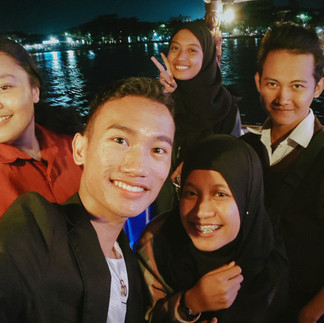
Check out more mesmerizing pictures like the one above below.








Comments